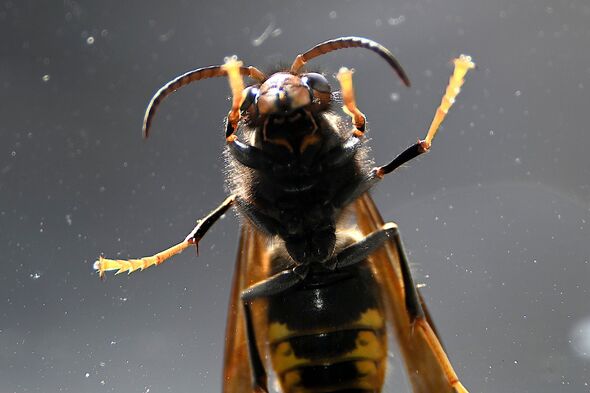

Record numbers of invasive Asian hornets were spotted last year - as new evidence found in 2026 shows this bee-killing pest has spread further across the UK than previously thought.
The insect, also known as a yellow-legged hornet, is a harmful invasive species originating from east Asia and was first recorded in Europe in 2004.
Earlier this month, a dead nest was found near Wrexham, prompting calls from the Welsh Government for people to be “vigilant” in the coming months and to report any suspected sightings.
It is the first confirmed discovery of the insect in Wales.
It follows a record year for Asian hornet sightings in the UK. In 2025, 161 nests were found and destroyed. A record 176 sightings of the insect have so far been confirmed by lab tests, but Defra (the Department for Environment, Food & Rural Affairs) says there were 544 credible sightings last year.
The previous record was in 2023, when there were 57 confirmed sightings and 73 nests destroyed.
Huw Irranca-Davies, deputy first minister of Wales, said: “The National Bee Unit has years of experience tracking and locating yellow-legged hornets so their expertise will be invaluable in helping us take action against the insect in Wales.
“I’d like to thank beekeepers and members of the public who I know remain alert and continue to report suspected sightings
“We need everyone to become familiar with what yellow-legged hornets look like.
“As the weather warms up in the spring and especially on into the summer, please continue to be vigilant.”
The British Beekeepers Association is very concerned about the influx of these “non-native predators that can wipe out honey bee colonies and devastate native insect populations”.
A single hornet can kill between 60 to 90 honeybees in a day, and groups of them will “hawk” a hive at any one time by decimating the bees.
Unlike species with more specialised diets, they are opportunistic hunters - feeding on some 1,400 different insect species, including honey bees, bumble bees, butterflies, hoverflies and beetles.
You can see if any Asian hornets have been spotted near you using our interactive map.
It is believed a hornet first arrived in Europe in a shipment of Chinese pottery bound for France in 2004.
But it was not until 12 years later, in 2016, that hornets were found in the UK for the first time in Tetbury, Gloucestershire.
Asian hornets are slightly smaller than European hornets and can be identified by their distinct markings. They have yellow legs, an orange face, and a dark black/ brown body with one yellow or orange stripe on the lower abdomen.
Sightings can be reported via the Asian Hornet Watch app - which is available to download
for Android and Apple device - online at irecord.org.uk/enter-non-native-records or by emailing alertnonnative@ceh.ac.uk.
For guidance on how to report and spot Asian hornets, go to: https://www.nonnativespecies.org/non-native-species/species-alerts/#Species_53