 PA Media
Was it enough?
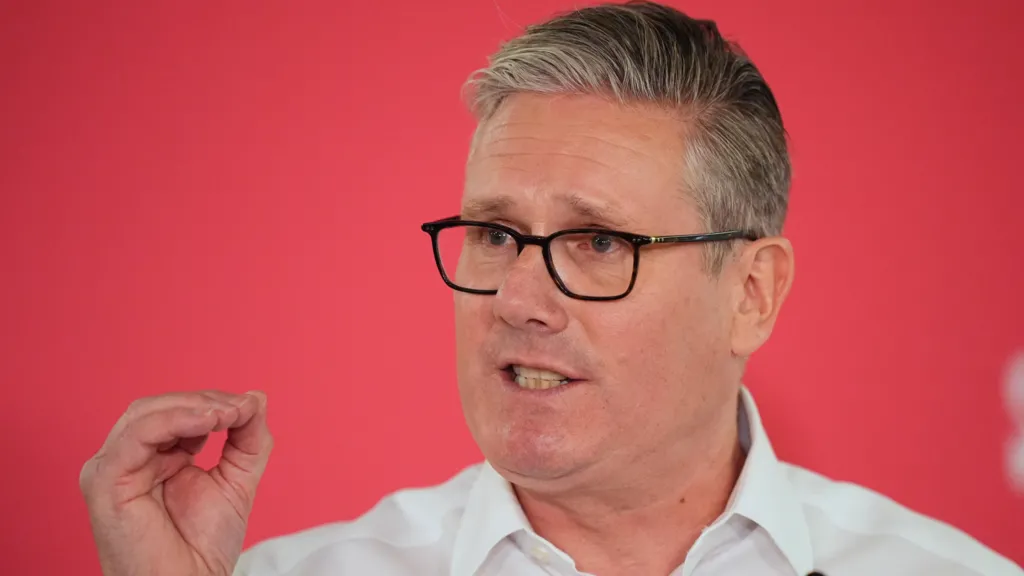
That is the question that matters after Sir Keir Starmer's speech.
Was it enough to avert a challenge to the prime minister's leadership less than two years after he won a landslide general election victory?
In the first instance, the person whose answer to that question matters most - and this would have sounded like a strange joke just two days ago - is Catherine West.
West, until the last 48 hours a relatively unknown former minister, told the BBC on Saturday night she was willing to try to force a leadership contest if no one else came forward.
But having heard the prime minister's speech, she is standing down from running as a stalking horse candidate and trying to trigger a formal leadership contest right now.
A sigh of relief, in the immediate moment at least, for Downing Street - and for the Mayor of Greater Manchester Andy Burnham, as she is now advocating that the prime minister sets out a timetable for his departure, rather than leaving immediately. Burnham needs time to get back to Westminster first.
Those who have been organising the pro-Burnham push (or putsch) were concerned over the weekend that a swift contest would exclude him, as he is not an MP and needs to find a seat and win a by-election to be eligible.
So they tried to persuade West to abandon her plan, and adopt their own instead – and they see her statement today as a big win for them.
In the room for the prime minister's speech, the jeopardy hung heavy.
It was packed with loyalists willing Sir Keir on. It felt a little like a speech Iain Duncan Smith gave as Conservative leader in 2003, when, under intense pressure to stand down, he said "the quiet man is here to stay and he's turning up the volume". Those in the room punctuated his address with wild, perhaps over the top exuberant applause. He resigned three weeks later.
For Sir Keir's speech, there weren't many MPs there and no cabinet ministers. The party chair Anna Turley and Labour's deputy leader Lucy Powell were sitting in the front row.
The key figures to watch now then are Labour MPs.
One MP sent an unsolicited text, pointing out that the prime minister was introduced by a whip, those responsible for party discipline. The implication from the MP was this was evidence of desperation.
"That speech made me feel sorry for the PM. He looks panicky and out of his depth.
"I watched that thinking of all my constituents who told me on their doorsteps in the last few weeks that he has to go and they won't vote Labour until he does. There was nothing there for them," they texted.
While some were impressed by the prime minister's demeanour and rhetoric, those craving a new policy agenda were disappointed.
The announcement of the nationalisation of British Steel was new, albeit widely expected, but as a number of Labour figures pointed out even this 'big offer' came with a Keir-like cautious caveat: "subject to a public interest test".
But a much-anticipated section on Europe was just a restatement of existing government policy, and while some had been pressing for it, there was no future manifesto commitment to joining the single market or customs union.
There was no shortage of MPs who gave their post-match analysis.
"Woeful".
"That really didn't cut the mustard."
"He is damaging the party and the country."
Another says it was delivered like he was "delivering a planning application".
"A waste of our time", and perhaps the most succinct reaction: "meh".
But some of the verdicts weren't just from long-standing critics or those with a dog slavering to get in to the fight.
Someone who has been close to Sir Keir pointed out there was "no substance on the cost of living - no pound in your pocket answers" and "nothing substantive on immigration and defence".
In other words they think he hasn't quite proved that he can "rise to the moment".
Around 40 MPs have now said they want the prime minister to go publicly. But at least some of them say they want him to set a timetable for an "orderly transition", which is in line with what is now Catherine West's position.
In many cases, an "orderly transition" is code for an orderly transition to Andy Burnham. Starmer's answer after the speech on whether he would block Burnham from seeking to return to the Commons, as he did earlier this year, was ambiguous.
That may bring clarity closer. If, as some of his supporters claim, Burnham has a route back to Parliament in the form of an MP willing to resign and trigger a by-election, then surely the coming hours and days are when he must make that clear.
Final thought: what does Health Secretary Wes Streeting, another plausible contender for the leadership, do now? The vehicle for discontent to boil over today or this week – West's challenge – has gone.
So does he have the numbers and is he willing to move – particularly if it is harder for him to point to Sir Keir's authority disintegrating because there is already a challenger?
One MP urged Streeting to go for it, saying: "It's now or never unless you're Burnham."

Sign up for our Politics Essential newsletter to keep up with the inner workings of Westminster and beyond.

94 PerFlyer
96 PerFlyer