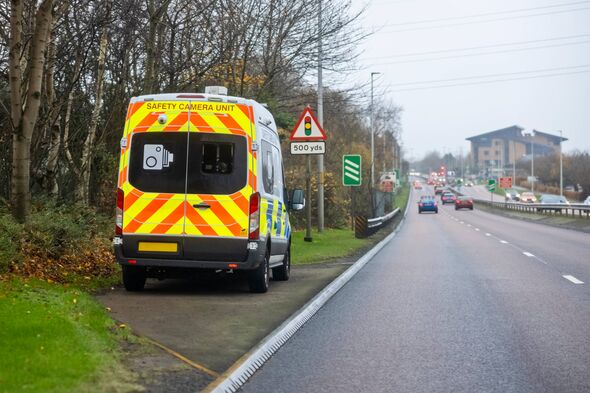

A significant development has emerged regarding the growing practice of drivers making a mockery of speed cameras by fitting 'invisible' number plates to their vehicles. Authorities have been working to crack down on the scam, in which rogue motorists are dodging fines using so-called 'ghost plates' that remain undetected by both speed and bus lane cameras.
These illegal plates, also referred to as 3D or 4D, are firmly in the sights of police equipped with cutting-edge technology designed to catch these offenders. Previously, a senior official responsible for the UK's Automatic Number Plate Recognition system highlighted that approximately one in 15 drivers were outsmarting the system — an issue described as 'staggeringly simple' by former Biometrics and Surveillance Camera Commissioner Professor Fraser Sampson.
Now, as part of a sweeping overhaul of motoring offences, police and road safety organisations have warned the Government that certain offences do not carry sufficient additional penalties, such as penalty points or vehicle seizure. It can be revealed that the Department for Transport is considering toughening up the penalties for a number of offences — including so-called 'ghost' plates.
The government has been conducting a consultation on its Road Safety Strategy — with the deadline for submissions having passed last week.
One key area under consideration for tougher penalties is 'ghost' number plates, with proposals that police should be granted the powers to impose penalty points and seize vehicles on the spot if drivers are found using false plates or those designed to deceive cameras.
Former Biometrics and Surveillance Camera Commissioner Professor Fraser Sampson previously wrote to the then government outlining how offenders are cloning number plates, applying reflective tape, and obtaining 'stealth plates' to evade speeding fines and low-emission zone charges.
Prof Sampson has voiced serious concerns regarding the vulnerabilities of Automatic Number Plate Recognition (ANPR) systems, despite significant technological progress and their pivotal role in law enforcement operations. He warned: "For all its technological advancement and operational indispensability, the ANPR system still relies ultimately on a piece of plastic affixed to either end of a vehicle.
"Served by a wholly unregulated market, what my predecessor termed the humble number plate represents a single and readily assailable point of failure with the ANPR network being easily defeated by the manufacture and sale of stealth plates, cloned registration marks and other rudimentary obscurant tactics."
Lilian Greenwood MP stated the changes outlined in the Road Safety Strategy are designed to cut deaths and serious injuries on the roads - while ensuring police possess the necessary powers which are also proportionate to the offence. She wrote in a foreword to the consultation: "In 2024, there were 1,602 deaths on our roads – an average of around 30 a week, or 4 to 5 per day. There were also 27,865 serious injuries on our roads. Although the UK has some of the safest roads in the world, these figures remain far too high, and this government does not accept that these deaths and serious injuries are inevitable."
"With the number of UK road deaths having plateaued since 2010, it's clear that strong, decisive action is long overdue. The government recognises the need to take action now to reduce casualties and damage on our roads. There is no silver bullet of one measure that will drastically reduce road death. Real progress will come when a range of measures work together, systematically and consistently, towards a common goal."
The strategy examines multiple areas including drink and drug driving, medical fitness to drive - such as compulsory eye tests for the over-70s and failure to wear seatbelts. One area under consideration involves incidents which may require stricter penalties. The consultation stated: "Police and road safety groups have told the government they are concerned that some offences do not carry extra penalties, such as penalty points or vehicle seizure."
These include offences relating to: The strategy states that the change is necessary because criminals are exploiting legal loopholes. It explained: "It's harder for police to identify who is using a vehicle because some offenders go to great lengths to hide who owns it or who was driving – this makes it harder for the police to keep the public safe and pursue offenders.
"There is a significant amount of evidence of disguising a vehicle's true ownership to avoid compliance with vehicle excise duty requirements and other payment requirements for the use of certain roads. This places an additional burden on those law-abiding drivers when the revenue shortfall to the treasury due to fraud has to be made up.
"The police currently have the powers to seize a vehicle from those driving whilst uninsured, or not in accordance with their driving licence. The use of this power has to be proportionate and allows police to use their discretion not to seize where they feel that is an appropriate decision based on the merits of each situation." On the matter of motor insurance, the government has drawn attention to the disparity in penalties between making a fraudulent declaration to obtain motor insurance and driving without insurance. At present, while the false declaration offence can result in imprisonment and fines if brought before a court, the majority of cases do not reach that stage — and there is no provision to impose penalty points or disqualify the offending driver. By contrast, the penalties for driving while uninsured comprise a fixed penalty of £300 and 6 penalty points, or if the matter proceeds to court, an unlimited fine and/or a driving disqualification.
A summary of responses is due to be published within the next 3 months, ahead of the government moving to amend the legislation later this year.

131 PerFlyer