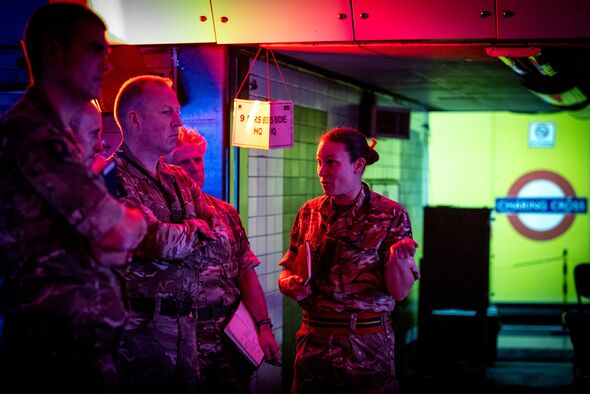

The British Army has taken over a disused platform at a London Underground station to rehearse tactics for a future war with Russia. The exercise, named ARRCADE STRIKE, is designed to replicate how a NATO reaction force would respond to a conflict with Moscow.
Set in Estonia in 2030, 120 soldiers have been put through their paces, simulating a situation in which NATO Article 5 – an attack against one is an attack against all – has been triggered and British forces must work with NATO Allies to deter, strike, and if necessary, restore NATO territorial integrity.
READ MORE: WW3 fears soar as RAF metres away from Putin's jets in 'dangerous' confrontation
READ MORE: Starmer has finally stood up to Rachel Reeves and the Left – too little too late

The exercise has been held this week in Charing Cross station, with soldiers training and developing tactics learned from Ukraine’s war in response to the increased prevalence of drones on the modern day battlefield.
Led by the Allied Rapid Reaction Corps (ARRC), NATO’s Corps Level offensive manoeuvre formation, the exercise brought together hundreds of personnel from across the UK and Allies from France, Italy and the USA to test the Alliance’s ability to plan and command complex operations involving up to 100,000 personnel, from deep underground.
The exercise integrated capabilities across land, sea, air, space and cyberspace and demonstrated how forces will operate together in the future battlefield.
Secretary of State for Defence John Healey MP said: “We're transforming our Armed Forces and delivering on our NATO-first commitment to boost deterrence and ensure we can keep the UK and our allies safe.
"This groundbreaking Army exercise shows that with UK leadership, the ARRC can deploy at pace to command tens of thousands of troops to defend NATO territory. We are investing in our people and cutting edge tech and stepping up on European security."
Command posts can be a prime target for long-range missiles, drones and electronic surveillance, so operating from deep underground and commanding forces from long range increases the Army’s ability to fight and win the conflicts of today and tomorrow.


Lieutenant General Mike Elviss, Commander ARRC, said: “ARRCADE STRIKE is an important milestone in building the ARRC into a modern warfighting headquarters, one able to command at the scale and complexity required to deter aggression and, if necessary, fight and win.
“We are demonstrating the UK’s leadership within NATO and our determination to ensure the Alliance remains ready, resilient and credible.”
The exercise comes as governments across NATO rush to expand their ability to produce and deploy drones, with the war in Iran highlighting their effectiveness at a fraction of the cost of conventional missiles and weapons.
MOD sources indicate that the British military has only a week’s worth of the number of drones required in a conventional war.
Industry figures have previously expressed frustration with UK leaders over their tardiness in providing funding to the MOD to allow them to enact recommendations made in last year’s Strategic Defence Review (SDR).
The Defence Investment Plan, the means by which the government will set out how modernisation will be funded, was scheduled for release last Autumn but has yet to be released amid wrangling between defence leaders and the Treasury over funding.