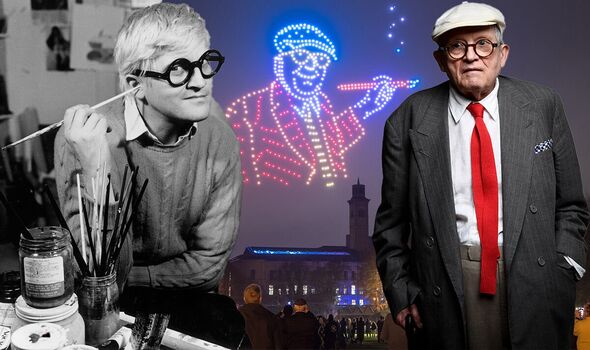

David Hockney, who has died aged 88, was Britain’s best-loved and most famous artist by a country mile. Instantly recognisable for his round spectacles, oversized suits and trademark flat caps, plus his peroxide blonde hair, he was a genius who created bold and unorthodox prints.
Hockney, who died peacefully at home on Thursday, was best known for his swimming pool paintings that defined Californian’s carefree existence but also for his portraits, American landscapes and, later, for scenery of his native Yorkshire.
In 2018, one of his swimming pool paintings sold at auction for nearly £70 million – at the time, a record for a living artist.
Prime Minister Keir Starmer led tributes to Hockney, describing him as “one of Britain’s most celebrated artists”. A spokesman for Number 10 said: “His vivid, instantly recognisable work influenced generations of artists, and the Prime Minister’s thoughts are with his friends and family.”
Alex Farquharson, director of Tate Britain, where a major Hockney exhibition is due to open in October 2027, said: “David was an endlessly inventive artist, with a unique vision of the world. He was always completely and courageously himself, both in his work and in life.“He taught us about the joy of looking, seeing things the rest of us failed to notice – his witty and sharp observations, a constant presence within his work and in person. The loss to the art world is immense.”
Artist Dame Tracey Emin called Hockney a “great artist and a wonderful man, who with the power of art changed the perception of Britishness”.

Ever the pioneer, Hockney never feared embracing new media. In addition to his traditional painting, he experimented with photo-collage, drawings, etchings, lithographs, photocopiers, stage design, stained glass and, in his later years, digital art on an iPad computer. One simple piece of advice drove him: “Paint the things you love.”
Hockney was born in Bradford, in 1937 – the fourth of five children – to father Kenneth, an accountant, and mother Laura, a housewife and strict methodist. Both parents were staunchly political socialists. The artist once described his upbringing as “radical working-class”.
Early on in his life, in 1940, disaster very nearly struck during a Second World War air raid. All seven members of the Hockney family were sheltering beneath the stairs in their terraced house when a stick of bombs landed nearby, shaking their house to its foundations.
Hockney attended Wellington Primary School, Bradford Grammar School and then Bradford College of Art. At the latter, he said, most of his teachers seemed content simply to churn out future employees for the advertising and printing trades. In order to study pure painting, he had to lie and pretend he planned on becoming an art teacher.
As a young man, he was lured by the major art galleries of London. Always hard up for cash, he and his friends would leave school on a Friday evening and hitchhike to the capital overnight. Arriving early morning they would buy a ticket for the Circle Line and do laps of the Tube, sleeping until the galleries opened. Then, still half-asleep, they would visit as many exhibitions as possible, before hitchhiking back to Yorkshire.

Hockney avoided national service by claiming to be a conscientious objector, working as a hospital orderly in Bradford instead. One rather unpleasant job involved applying ointment to patients with skin diseases, while another required him to wash dead bodies in a mortuary.
In 1959 he embarked on a course at London’s Royal College of Art. It was here he first realised he was gay at a time when homosexuality was still illegal in the UK.
“I suddenly felt part of a bohemian world,” he later said. “A world about art, poetry and music. I finally felt I belonged. I met kindred spirits and the first homosexuals who weren’t afraid to admit what they were. I thought, ‘I like that. That’s the way I want to live. Forget Bradford’. Once I accepted all this, it gave me a great sense of freedom.”
Buoyed with confidence, his painting blossomed and signed with his first art dealer. In 1961 he visited America for the first time. Staying in New York, he was watching TV one evening with friends when he saw an advert for a hair dye called Lady Clairol, with the catchphrase “Is it true blondes have more fun?”
This prompted him to turn blonde himself – a look that would define him for most of his working life.
In the mid 60s he moved to Los Angeles, where the bright light, blue skies, angular buildings and ubiquitous swimming pools inspired some of his most famous paintings. It was around this period he created The Splash, A Bigger Splash, and Portrait of an Artist (Pool with two Figures), cementing his place at the spearhead of Britain’s pop art movement.
His work rate proved to be prodigious. Back in London, he once hung a sign at the foot of his bed, instructing himself to “Get up and start work immediately.”
In the 1970s he branched out into set and costume design for operas and ballets. He claimed a neurological condition called synesthesia – which causes music to trigger the visualisation of colours – influenced his work in these fields. In 1997 he found out his old friend Jonathan Silver was dying of pancreatic cancer. To be near to him, he moved back to Yorkshire, to the town of Bridlington, where his mother lived.

During the summer he would regularly drive across the Yorkshire Wolds to visit his friend.
“It made me see the living aspect of the landscape,” he said. “Some days were just glorious, the colour was fantastic. I can see colour. Other people don’t see it like me, obviously.”
2013 was a particularly dark period for the artist when his 23-year-old assistant Dominic Elliott was found dead at Hockney’s home, having consumed household drain-cleaning fluid. Death by misadventure was the official verdict. However, Hockney was so upset by his friend’s death that for a while he considered giving up art altogether. In 2015, he moved to Normandy, in France, where the changing seasons inspired a new direction of landscape painting full of trees and rich colours.
During his later years, by now firmly a national treasure, he staged groundbreaking exhibitions. One highlight was an immersive show at the Lightroom gallery in London, where his paintings, photographs, opera sets, drawings and collages were projected onto the gallery walls and floor, all to the accompaniment of video, music, sound effects and narration in his own dulcet Yorkshire tones.
Quite rightly, Hockney was one of the most decorated artists of his generation. Yet he was never keen on awards, viewing them as “a bit suspect”.
He rejected a knighthood in 1990 and once turned down the opportunity to paint a portrait of Queen Elizabeth II. But he did accept the Order of Merit in 2012. Viewing it as a personal gift from his monarch, he felt it would be disrespectful to turn it down.
There was one more unusual tribute he enjoyed very much, however. As a lifelong smoker and vociferous campaigner for smokers’ rights, he was delighted when, at his 70th birthday party at the Tate Britain in London, the gallery alarms were turned off for ten minutes after dinner to permit “Britain’s greatest living artist” a cheeky cigarette break.
Hockney is survived by his long-time companion, photographer and musician Jean-Pierre Gonçalves de Lima, and his brothers Philip and John.
19 PerFlyer