
Two previously unknown sermons written by St Augustine have been uncovered in an ancient manuscript, offering fresh insight into one of the Bible's most puzzling and controversial stories.
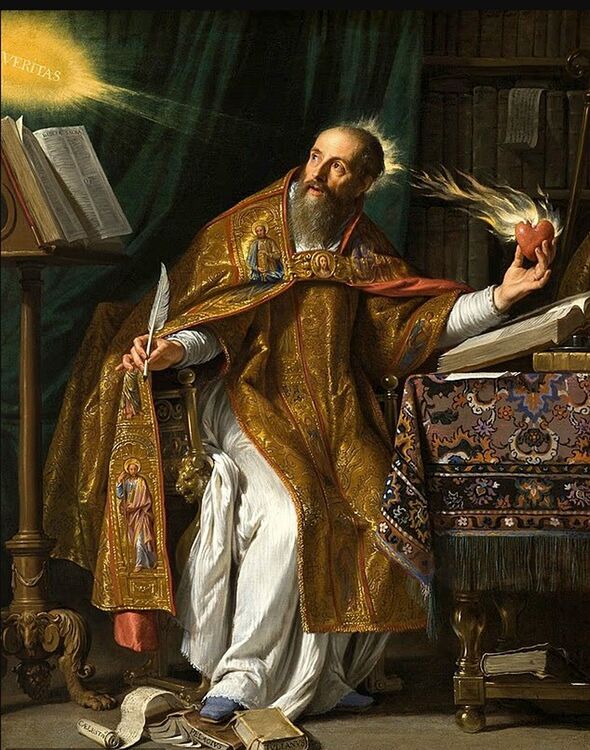
The texts, discovered in a manuscript held at a library in Poland, were written by the influential theologian whose teachings helped shape Western Christianity. St Augustine is widely regarded as one of the most important Christian thinkers after the Apostle Paul.
The newly identified sermons examine the story of King Saul and the Witch of Endor, an episode described in 1 Samuel 28 in which the dead prophet Samuel appears and predicts Saul's death.
For centuries, the passage has sparked debate among Jewish and Christian scholars because it appears to show a medium successfully summoning a dead prophet.
In the sermons, St Augustine wrestles with that question, considering whether Saul genuinely encountered Samuel or whether the figure was a supernatural deception.
He ultimately concluded that the Witch of Endor had no power over the dead. If Samuel did appear, Augustine argued, it could only have happened because God permitted it rather than through any magical ability on the part of the medium.
Professor Christian Tornau, a Latin scholar at the University of Würzburg, said: "The first was preached during the Sunday service and ends with the theodicy question and the interpretations.
"It was not until the second sermon on the following Wednesday that the options were weighed up."
Augustine lived between 354AD and 430AD. Born in North Africa to a pagan father and a devout Christian mother, he spent much of his early life exploring different philosophical and religious traditions.
Before converting to Christianity, he embraced a hedonistic lifestyle and followed Manichaeism, later turning to Neoplatonism in his search for answers.
After experiencing a profound spiritual crisis, he converted to Christianity and was baptised in Milan in 387.
The discovery was made in 2024 after Professor Tornau was asked to decipher six sermons attributed to Augustine. During the work, he realised that two of the texts had never previously been identified.
Both newly discovered sermons focused on the Old Testament account of Saul's encounter with the Witch of Endor.
Explaining the biblical story, Tornau said: "Saul believes himself to be in a hopeless situation shortly before a battle against the Philistines. God does not listen to his prayers. He turns to a witch."
At Saul's request, the woman summons what appears to be the spirit of the prophet Samuel, who predicts the king's death in battle. According to the Bible, Samuel had previously anointed both Saul and David as kings of Israel on God's instruction.
The account has long raised difficult theological questions about whether a witch could truly summon a prophet from the dead.
Latin scholars have also asked: "How can an omnipotent God allow this or is he not really omnipotent?"
For generations, theologians have debated whether the apparition was a trick, a demonic illusion or a genuine appearance of Samuel allowed by God as a warning to Saul.
Researchers noted that Augustine did not impose a definitive interpretation on his congregation. Instead, after presenting the arguments in the two sermons, he left listeners to reach their own conclusions.
According to Tornau, this approach reflects Augustine's wider teaching style, as he frequently explored multiple interpretations before allowing audiences to decide for themselves.
"The style, humor and content also clearly indicate that the sermons in the manuscripts were actually written by Augustine," he said.

Because works have previously been misattributed to the saint, the researchers carried out an extensive authentication process.
Tornau and Dr Clemens Weidmann of the Corpus Scriptorum Ecclesiasticorum Latinorum (CSEL) enlisted 20 additional Latin scholars to examine the texts and verify their authenticity.
Tracing the history of the sermons proved challenging.
"Firstly, the creation of such a manuscript in the 12th century is unusual. A copy at the beginning of the 8th or 9th century would be more typical," Tornau said.
Researchers believe the sermons survived because a medieval scribe copied them from an earlier manuscript that has since disappeared.
"An old catalogue from the monastery mentions a text with the same headings and the same sequence of contents as our manuscript," Tornau explained.
"It could have served as a model."
However, he noted that the theory cannot be confirmed with complete certainty because the monastery's library collection was destroyed during the Thirty Years' War, which lasted from 1618 to 1648.