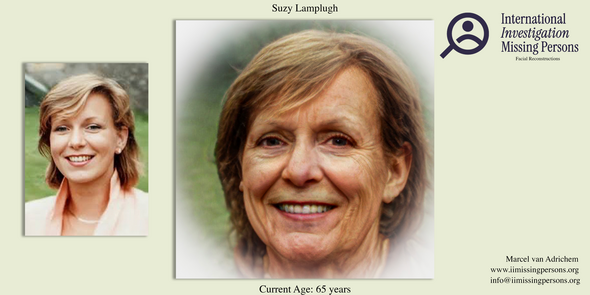

A newly unveiled age-progression image of missing estate agent Suzy Lamplugh has been released in what experts hope could spark a crucial breakthrough in one of Britain’s most haunting cold cases.
The powerful new reconstruction, created by forensic artist Marcel van Adrichem, shows how Suzy might appear today at the age of 65 — almost four decades after she vanished during a house viewing in Fulham, west London, in July 1986.
Suzy, 25 at the time, was showing a property in Stevenage Road when she disappeared. Although she was officially declared dead, presumed murdered, in 1993, the Metropolitan Police have repeatedly stated that her disappearance remains an active cold case.
The investigation has been one of the largest and most complex missing-person inquiries in British history, involving multiple major police reviews, nationwide appeals and specialist cold-case teams. Detectives have consistently maintained that new information — however small — could still be vital.
The prime suspect in the case was serial killer John Cannan, who died in prison in 2023 while serving a life sentence for the murder of Shirley Banks. He was long believed by police to be responsible for Suzy’s disappearance, but was never formally charged and has always denied involvement.
Read more: Desperate search for missing teens launched as cops 'increasingly concerned'
Read more: Discovery of new personal letter from Claudia Lawrence like 'hearing her voice'

The new image aims to challenge the way the public remembers Suzy — not as a young woman frozen in time, but as a living person who may still be recognised today.
“To me, a cold case is never just a closed file; it is an unfinished story crying out for an ending,” Mr van Adrichem said. “My passion lies in breaking that years-long silence. While the world moves on, I keep digging. I see it as my mission to use forensic precision to build a bridge between the past and the present.”
“A facial reconstruction does something unique to the human brain,” Mr van Adrichem explained. “It forces us to stop seeing someone as a fading memory and start seeing them as a living person in the ‘here and now.’ This shift in perspective is vital.”
He added that while reconstructions do not always lead directly to physical discoveries, they can reignite public awareness and prompt fresh leads.
“Every wrinkle I add to a face like Suzy Lamplugh’s is an act of defiance against oblivion. I bring them back from the shadows of time, not just for the sake of justice, but for the truth they still deserve. Because justice has no expiration date.”
Mr van Adrichem, who has previously reconstructed the faces of historical figures including John F. Kennedy, Marilyn Monroe and John Lennon, said working on cold cases carries a far deeper emotional weight.
“This project is more than a forensic process; it is a tribute to a woman who must never be forgotten,” he said. “As long as a face remains recognisable, the hope for the truth remains alive.”
Police and campaigners continue to urge anyone who may recognise the image, or who has information about Suzy’s disappearance, to come forward — no matter how insignificant it may seem.
Suzy Lamplugh’s case remains one of Britain’s most enduring mysteries, but experts hope this latest reconstruction could help generate the fresh lead needed to finally uncover the truth.