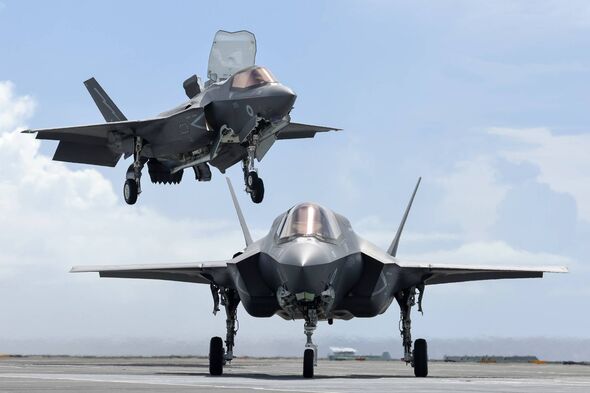

Britain's state-of-the-art stealth jets were deployed to a potential Middle East flashpoint without sufficient spare parts to maintain operations, a damning report has disclosed. Alarming global conflict concerns have heightened after it was revealed that a Royal Navy aircraft carrier was dispatched to the region carrying twice the number of F-35B Lightning jets it possessed the supplies to service.
The Ministry of Defence (MoD) has faced severe criticism for its "half-baked approach" and "entirely unacceptable incompetence" from incensed MPs. A letter from MoD Permanent Secretary Jeremy Pocklington revealed how 24 of the advanced, missile-equipped warplanes were packed onto a Queen Elizabeth-class carrier for Operation HIGHMAST.
The spare parts inventory onboard was only sufficient to support 12 aircraft, according to the UK Defence Journal. Military commanders were compelled to urgently requisition supplies from RAF Marham in Norfolk and deplete other emergency reserves simply to maintain the £100million jets operationally.
The error provoked a sharp rebuke from Public Accounts Committee (PAC) Chair, Sir Geoffrey Clifton-Brown.
He said: "At the heart of any military planning is sound logistics. The UK sent an aircraft carrier with 24 F-35 fighter jets on it to the Middle East - with not enough spare parts to support them."
Read more: Keir Starmer just humiliated the UK - 1 big decision is needed to avoid oblivion
Read more: Navy top brass warns UK set to lose the Atlantic to Russia
"Twelve aircraft spare parts packs were sent to service twenty-four aircraft, and it is no surprise that as a result spares had to be shipped out from RAF Marham to make up the difference."
He cautioned that with global tensions reaching boiling point, British forces must not be left exposed by senior military leadership.
Sir Geoffrey said: "In an increasingly dangerous world, our military and the country need more than this half-baked approach from the MoD.
"Our brave fighting men and women, before being sent into potential harm's way, must have absolute certainty that they are well-supported in their equipment, with clear and reliable supply lines.

"But this correspondence shows an entirely unacceptable incompetence that flies in the face of any kind of sensible planning from the Ministry of Defence."
The aftermath of the deployment has left the UK's fleet grappling with a backlog of maintenance problems.
The MoD has acknowledged that disruptions to the global supply chain mean meeting future objectives is improbable.
Making matters worse still, the multi-million-pound aircraft are experiencing corrosion damage from exposure to salty sea air.

Engineers are now wrestling with an enormous maintenance backlog to address the problem, resulting in a short-term drop in the number of aircraft available for operations.
The military is also confronting a severe manpower shortage. The Lightning Force is currently short of a quarter of its required engineers because RAF Marham is regarded as a "less preferred posting location."
The RAF has conceded it will take until 2032 simply to recruit enough fully qualified mechanics at the base. The MoD was also forced to urgently purchase American bombs as an interim solution to guarantee the F-35s possess adequate missile capabilities ahead of the long-awaited British SPEAR-3 cruise missiles becoming operational.