This week, with air raid warnings wailing in the distance, Kyiv held a funeral for two sisters.
12-year-old Liubava and her 17-year-old sister Vira were among 24 civilians killed by a Russian missile which reduced their residential block to rubble earlier this month. They had already lost their father who had been fighting on the front line. Their grieving mother is now the family's sole survivor.
This is the human cost of the largest sustained Russian aerial assault so far – with 1,500 drones and 56 missiles fired at Ukraine within 48 hours.
But the loss of life could have been even higher. Ukraine's air defences prevented more casualties. According to President Volodymyr Zelensky, 94% of those long range drones and 73% of the missiles were successfully intercepted. In comparison, on 14 May 2025, Kyiv's forces took down 55% of Russian drones launched nationwide. Ukraine is getting better at defending its skies.
"We are now, unfortunately, the best in the world," says Lt Col Yuriy Myronenko, an inspector general at Ukraine's Ministry of Defence. He admits, though, that shooting down Russia's ballistic missiles "is not so easy".
 Lee Durant/BBC
More than four years on from Russia's full scale invasion, Ukraine has built an increasingly sophisticated, layered air defence system.
At the start of the war it relied on old Soviet-era weapons. The West then helped bolster its defences – with expensive, more sophisticated systems including Patriot air defence missiles.
But Ukraine has also been developing its own home-grown solutions – from mobile fire teams operating heavy machine guns on trucks to cheap, mass-produced interceptors.
Embracing innovation and technology is giving Ukraine an advantage. At the heart of Ukraine's air defences is the software that tracks every glide bomb, missile and drone launched by Russia.
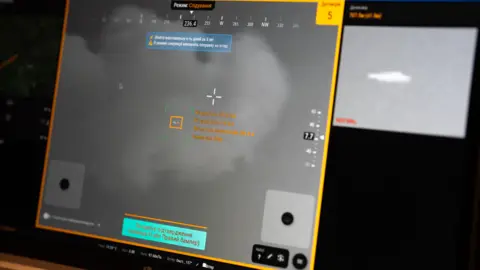
Sky Map uses radars, thousands of sensors and video feeds and artificial intelligence to detect threats and guide its air defences.
To start with, Ukraine relied on a network of mobile phones fitted on to telegraph poles to listen out for the sound of approaching drones. Now the system uses more sophisticated sensors.
The US is using Sky Map to protects one of its bases in the Middle East.
And there's one weapon, more than any other, that's helping take down Russian drones: cheap interceptor drones.
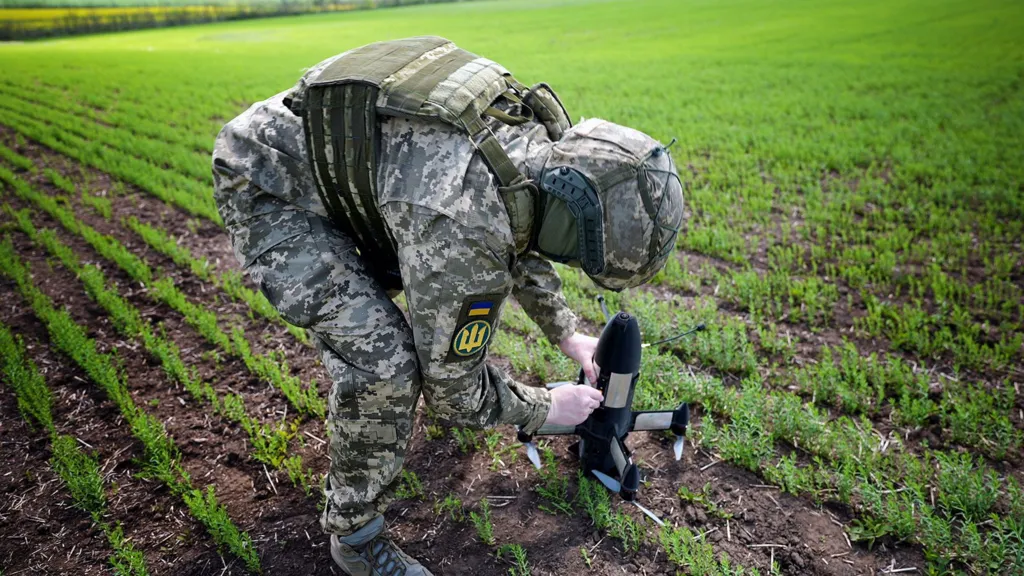
They're shaped like a large bullet and propelled by four rotors at the base. Ukraine is now producing more than 1,000 of these kinds of drones a day. In March this year they destroyed more than 30,000 Russian drones, according to Ukraine's air force.
In a field outside the city of Kherson, Ukraine's Marine Corps Unmanned Systems Regiment shows one in action.
From a static launch their P1-SUN interceptor can reach speeds of more than 300km/h (186mph) with a range of more than 30km. The unit had just completed a mission to take out Russian drones.
Welkos, the commander, calls it a "very serious weapon". "It shows how quickly we can adapt, how we can hold the line and how much we can develop," he says. The P1-SUN is 3D-printed and costs around $1,000 (£750) – much less than the large $50,000 delta-winged Shahed one way attack drones that it is designed to destroy.
Private companies are plugging into the system too.
"We need to cover all of Ukraine and see all the targets. So accordingly, we use all the resources we have," explains Myronenko, who oversees the initiative.
Twenty-five companies have already signed up to the scheme. There is an obvious incentive – to protect their factories and infrastructure. Russian attacks on Ukraine's energy grid during the winter left millions without power.
Carmine Sky is one of the private companies now offering air defences for other private sector clients. They've already built a network of towers fitted with remotely controlled machine guns in the Kharkiv region - close to Russia's border.
We visit their control room in the basement of a building. Rows of screens display Ukraine's Sky Map as it tracks Russian drones and jets.
Behind the screens are ordinary civilians – mothers, taxi drivers and veterans. Each has been vetted and trained for a few weeks before being allowed to operate one of the remotely controlled guns.
Ruslan, the company's spokesman, tells me their job "is not difficult". Operating the remote machine guns to shoot down drones "is like a computer game - just like an Xbox or PlayStation", he says.
 Lee Durant/BBC
Ruslan describes their role as a "supplement to the state's air defence structure".
"We're integrated into the military system," he says. "This is not the Wild West, so we follow the instructions and commands of the military."
Ruslan says there are other advantages to getting the private sector involved – "we can scale much faster than the public sector". It's early days, but these private companies have already shot down dozens of Russian drones.
Ukraine has also been stepping up its own attacks on Russia. Recent strikes have caused massive fires at Russian oil refineries across the country and have reached major cities like St Petersburg and Moscow, causing the Kremlin to reduce the scale of its World War Two Victory Day parade in May for fear of a Ukrainian attack.
As a result both sides are now in a battle to innovate as quickly as possible, to gain an advantage in this war. Russia has been developing faster jet-powered drones. It is now flying decoy drones to identify the locations of Ukraine's air defences.
There are still glaring gaps in Ukraine's air defences.
At one end there is a lack of highly sophisticated, expensive missile interceptors. Ukraine still needs US-made Patriot missiles. So far they're the only effective weapon to take down Russian ballistic missiles. With the US war in Iran they're in short supply.
Closer to the front line, Ukraine, like Russia, has struggled to deal with the threat of the prolific, small first-person-view (FPV) drones, which operators guide remotely to their target. They're still the cause of most casualties.
Despite the technical advances in this war – nets above roads, rifles and shotguns are still the last line of defence.
Defending Ukraine's skies will never be easy. President Zelensky has warned that Russia's mass attacks are designed to overwhelm its air defences.
By launching hundreds of drones and dozens of missiles it is inevitable that some will get through - meaning there will be more tragic deaths like sisters Lyubava and Vira.
Additional reporting by Firle Davies, Anastasiia Levchenko and Mariana Matveichuk

73 PerFlyer