 BBC
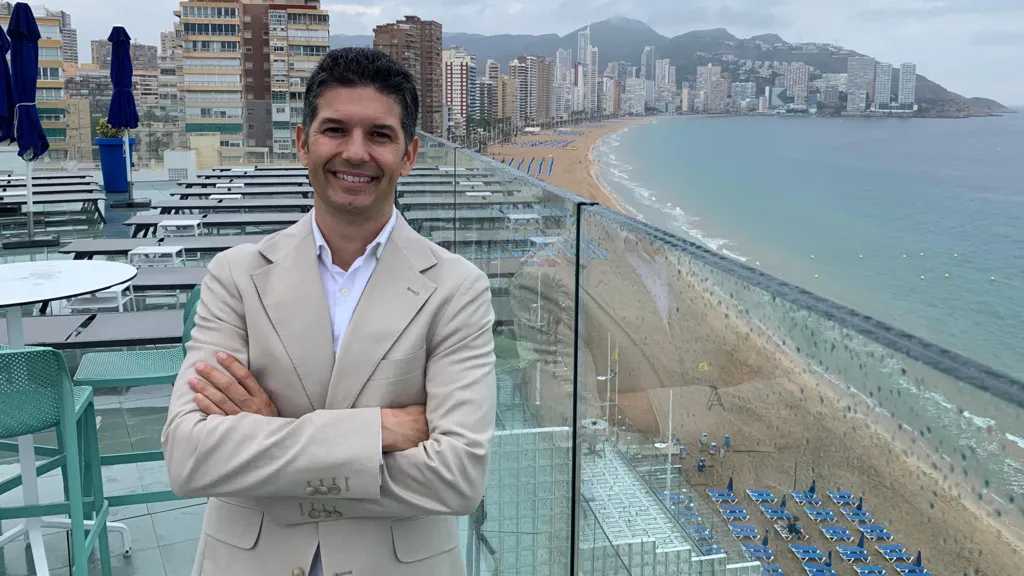
BBCFrom the rooftop terrace of a hotel, Fede Fuster looks out across Benidorm, at the nearby high-rise buildings and the town's famous, sweeping beach.
"With all its virtues and its defects this is a place we feel proud of," he says. "It's a place of opportunities."
Fuster is the president of the local tourism association, and his family was one of the first to build a hotel in this Mediterranean city, in the 1950s.
Benidorm's population is still only 77,000, but it swells to around five times that number in the height of summer, due to its status as one of Spain's prime tourism draws.
Since the Covid pandemic left resorts like Benidorm virtually deserted and the Spanish tourism industry at a standstill there has been a remarkable recovery. Foreign arrival numbers into the country have broken records each year, and totalled 97 million in 2025.
Currently the world's second-biggest tourist destination, just behind France, Spain is expected to consolidate its recent success in 2026.
"I think this is going to be a great year," Fuster says. "I'm optimistic, we're talking about reaching 100 million tourists in Spain. If we keep growing like this we're going to be number one [in the world] very soon."
Industry experts had originally expected 2026 to see more modest growth. But the outbreak of the US-Israeli conflict with Iran has made Spain an attractive alternative compared to Middle Eastern holiday destination Dubai, and countries in the eastern Mediterranean, such as Turkey and Cyprus.
"In these moments of crisis, of [military] strikes or wars, the bookings always increase," says Fuster, who recalls a similar phenomenon in 2011, during the turmoil of the Arab Spring, although he insists he would prefer to compete with other countries without this advantage.
"Any time that you have a crisis in the [eastern] Mediterranean or the Middle East, Spain is seen as a secure place to go," says Francisco Femenia-Serra, a lecturer in geography at Madrid's Complutense University.
He explains that "part of the tourists that would normally go to Turkey or Egypt because of the [low] prices, for instance, might end up in Spain".
Spain's official tourist arrival figures appear to bear this out. The country received 9.1 million international visitors in April, a new high for the month. This was 5.2% more, or 450,000 additional people, than April 2025.
Meanwhile, Dubai International Airport saw its passenger numbers drop by 66% in March as flights and bookings were significantly reduced due to the Iranian situation.
 AFP via Getty Images
With tourism directly contributing 13% of Spain's GDP, the industry has been a crucial component in the country's growth of recent years, which has outstripped that of France, Germany, Italy and the UK.
One cloud on the horizon is the possible impact of rising fuel costs, which could end up curtailing Europeans' foreign travel.
The other major concern for the Spanish industry is more domestic - growing anger among local residents at the impact tourism is having on their home environments.
"Tourism was always accepted as a positive economic sector for Spain," says Femenia-Serra. "That changed from 2016, 2017, with the label of over-tourism being put on some cities, like Barcelona.
"And now, most young Spaniards under 45 have a different image of tourism. They see it as a sector that obviously has a positive impact but also some negative outcomes in their lives."
Since 2024, Barcelona and many other tourist hubs, along the Mediterranean coast, in the Balearic Islands and the Canary Islands, have seen summer protests against perceived excessive visitor numbers.
A Europe-wide YouGov poll published in September 2024 found that 28% of Spaniards had a negative view of foreign tourism, by far the highest percentage of any country. The report also found that two-thirds of Spaniards sympathised with the protests.
Locals' grievances include the congestion caused by visitors in city centres, their environmental impact and, above all, the idea that they are exacerbating Spain's housing crisis. A new wave of protests at the country's soaring rentals has begun in recent weeks, with tourism often closely associated with the problem.
In a bookshop in the centre of Valencia, a group of local tenants meet regularly to discuss their housing-related problems with representatives of the Sindicat de Llogateres (Tenants' Union) activist group. Many of those who attend have seen their rentals increase sharply when landlords have revised their contracts.
"We have on the one hand the tourist accommodation market and on the other the residential market," says Jordi Vila, a representative of the Sindicat de Llogateres.
"When it comes to renewing rental contracts, the owners of properties no longer think about setting rents according to local salaries, but rather the salaries of people visiting from abroad, which might be three or four times higher. So local people end up getting pushed out of their homes."
He points to Barcelona, further up the Mediterranean coast, as the epitome of this phenomenon, describing the centre of the city as "a kind of theme park" where the proliferation of tourist accommodation has displaced locals.
In the northern region of Asturias, graffiti has been daubed in recent days on holiday rental properties, with the slogan: "Your business, our ruin."

While organisations such as the Sindicat de Llogateres continue to campaign, the left-wing coalition government has also identified tourist accommodation as a problem.
In 2025, Prime Minister Pedro Sánchez warned that "there are too many Airbnbs and not enough homes". In December, his government fined the holiday rental platform €65m ($75.5m; £56m) for advertising unlicensed apartments.
Local governments have also announced measures both aimed at curbing the growth of holiday accommodation and managing the large numbers of tourist arrivals.
Some city halls are restricting the granting of tourist-flat permits, and Barcelona has said it will revoke the licenses of all its 10,000 short-term apartments by 2028. It has also announced a doubling of the city's tourist tax to eight euros for those arriving on cruise liners for short-term stays.
Local activists applaud such measures yet demand more be done. The tourism industry, however, is concerned. The Exceltur tourism association has called for "the reparation of the links between the tourism sector and local residents".
The holiday apartment sector, meanwhile, has pointed to a report by PwC on the Barcelona licence-revocation plan, warning it could undermine the city's competitiveness and cause the loss of thousands of jobs.
Femenia-Serra says that cities are still searching for satisfactory formulas.
"We have measures that try to alleviate the impact that tourism has and that try to distribute tourists in cities in a different way," he says. "But we still haven't seen a single measure that is effective in reducing the number of tourists."
In Benidorm, as he ponders what looks likely to be another record-breaking summer for Spain, Fede Fuster acknowledges the backlash against his sector.
"We say we are the industry of happiness," he says. "But we also have to realise that we impact the normal life of citizens.
"The way we welcome people and we care about them and our happiness, the way we live, I think that's something the tourist really appreciates – that's the key," he explains.
"That's why we have to work a lot in these places, mostly in cities, where there is a feeling of not welcoming tourists. It's very important for us because if we lose that, we're dead."

Get our flagship newsletter with all the headlines you need to start the day. Sign up here.

130 PerFlyer

20 PerFlyer

85 PerFlyer