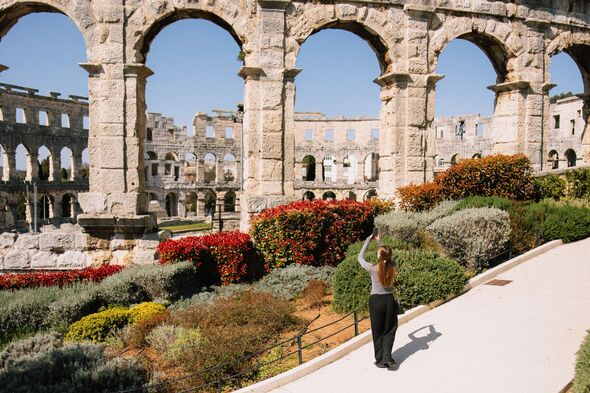

Like the city of Rome, Pula in Croatia was built on seven hills, a testament to its deep Roman heritage and strategic geographic planning. Today, these hills still form the backbone of Pula, offering gorgeous viewpoints across the city. After seeing Pula pop up on my TikTok last year and wondering where on earth this stunning city could be, I took a trip there to see what it had to offer.
I’ve seen many people choose Dubrovnik and Split for their holiday destinations, but never Pula, the largest city in Istria, situated in the north of the country. It’s known for its well-preserved Roman ruins, particularly the Pula Arena, which was arguably one of the most impressive sites I’ve seen.


Towering over the city for more than 2,000 years, the amphitheatre is one of the best-preserved examples of its kind anywhere in the world.
It was built between 27 BC and 68 AD, and almost the entire structure still stands today. In fact, it’s the only remaining structure of its kind to have all four side towers completely preserved.
Many people think of the Colosseum in Rome when they think about these structures, but the Pula Arena is actually older. Built from the famous white limescale of Istria, the Arena was a masterpiece of Roman engineering.
Where there are missing pieces, we learned that the Romans actually took them to build other structures.
I couldn’t believe how big it felt inside the Arena, with a capacity of 20,000 spectators. The Arena would have hosted gladiatorial battles under the Romans and knights’ tournaments in medieval times.
Today, it is still used as a performance space, with seating for over 7,000 people. It regularly hosts concerts, film screenings and cultural events.


There’s plenty to see above ground in the city, but beneath the pavement lies a hidden network of tunnels carved into the city’s limestone, and it was incredible to experience in person.
Known as Zerostrasse, the passages date back to the early 20th century and were built as a wartime shelter system. The tunnels are incredibly spacious, with enough room to walk freely and keep cool from the sun.
In the old town, overlooking Forum Square, stands the Temple of Augustus. It was originally dedicated to the Emperor Augustus, Rome’s first emperor and Julius Caesar’s adopted heir.
Despite being partially destroyed during World War 2, it was restored, and I enjoyed viewing it whilst enjoying a refreshing drink in one of the many cafes within the Forum Square.
There are also beaches close by if you wish to relax, and just a short drive from Pula, you can find Hawaii Beach, known for its crystal clear waters.
I stayed in the Park Plaza Histria Pula, which sits on the Verudela Peninsula, bordered by greenery and pebbly coves. It boasts a seafront location just a stone’s throw from a beach and four kilometres away from Pula.