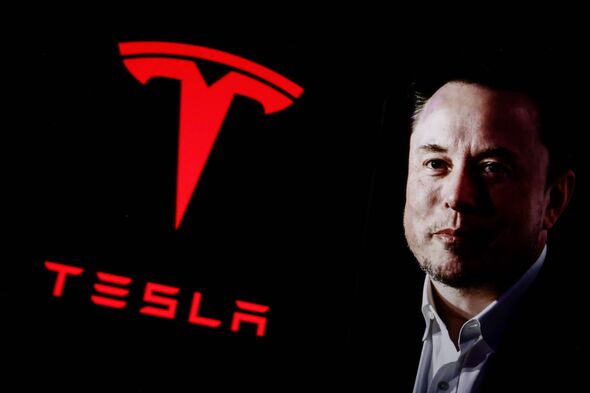

Elon Musk's automotive marque, Tesla, is a household name – yet the true significance behind the company's emblem remains somewhat enigmatic.
Over the years, observers have proposed numerous outlandish theories about the Tesla logo, with comparisons ranging from a pickaxe to an IUD to a cat's nose (a jest Musk himself embraced on social media). Nevertheless, none of these interpretations are especially accurate.
Despite seeing the logo on innumerable occasions, many are only now coming to this realisation. Interest was piqued on Reddit when one user enquired: "Other than the obvious 'T', what does the Tesla logo represent? I've heard it resembles a particular part of the engine?"
The letter T is an evident reference to the brand name, though it's also widely thought to hold deeper meaning. The badge displays a sleek, modern interpretation of the letter T, designed to depict the cross-section of an electric motor.
One user suggested: "The most plausible theory that I read was that it's part of a cross-section of an induction motor."
A second added: "It's fascinating to me how many plausible answers there are here. Whether it looks like a piece from an induction motor, or a power line, or a battery in an electrical schematic, or evokes the Model T, or is like Serbian axes, or even bears resemblance to Mr Tesla's face, it's clear that the logo is a great piece of design - regardless of whether it was intentional or not."
Tesla's iconic emblem was designed in 2004 by RO Studio, a New Jersey-based design firm that also created the SpaceX logo. It has undergone just one major change during its lifetime.
Originally, the "T" was contained within a silver, metallic shield. This was a deliberate choice by the designers to mirror traditional automotive badges (like Porsche or Lamborghini) and project a sense of security, reliability, and quality to consumers who remained highly sceptical of electric vehicles at the time.
The logo underwent a minimalist makeover in 2017, though. When Tesla dropped "Motors" from its name in 2017, it also scrapped the shield.
The emblem was simplified into a standalone "T," usually displayed in a vivid red, gleaming silver, or striking black. This sleeker, flatter look fitted seamlessly with modern digital design sensibilities and the brand's evolution from a traditional car manufacturer to a cutting-edge technology innovator.

It is widely assumed that Elon Musk founded Tesla, but this is inaccurate. The company was formally established as Tesla Motors on July 1, 2003, by two engineers and businessmen: Martin Eberhard and Marc Tarpenning.
They christened the company after Nikola Tesla, the celebrated 19th-century inventor and trailblazer of alternating current (AC) electricity. Elon Musk joined the company shortly afterwards in February 2004, leading its inaugural Series A funding round with a considerable financial commitment.
He took on the role of Chairman of the Board before eventually becoming CEO in 2008.
Tesla commenced deliveries of its flagship saloon, the Model S, in 2012. Eight years on, it claimed the title of the world's most valuable carmaker by market capitalisation.
By 2017, Tesla had acquired SolarCity and substantially broadened its reach into battery energy storage with products including the Powerwall.
In recognition of its transformation beyond a mere carmaker into a clean-energy and technology company, it officially dropped "Motors" from its name, rebranding as Tesla, Inc. Subsequently, in 2023, the futuristic stainless-steel Cybertruck entered production.
For the full year 2025, Tesla posted $94.83 billion in revenue. As of June 2026, Tesla's market capitalisation sits at roughly $1.41 trillion.
It comfortably maintains its position as the world's most valuable carmaker by a considerable margin, behaving far more like a high-growth tech stock than a traditional legacy vehicle manufacturer.