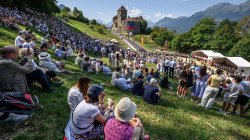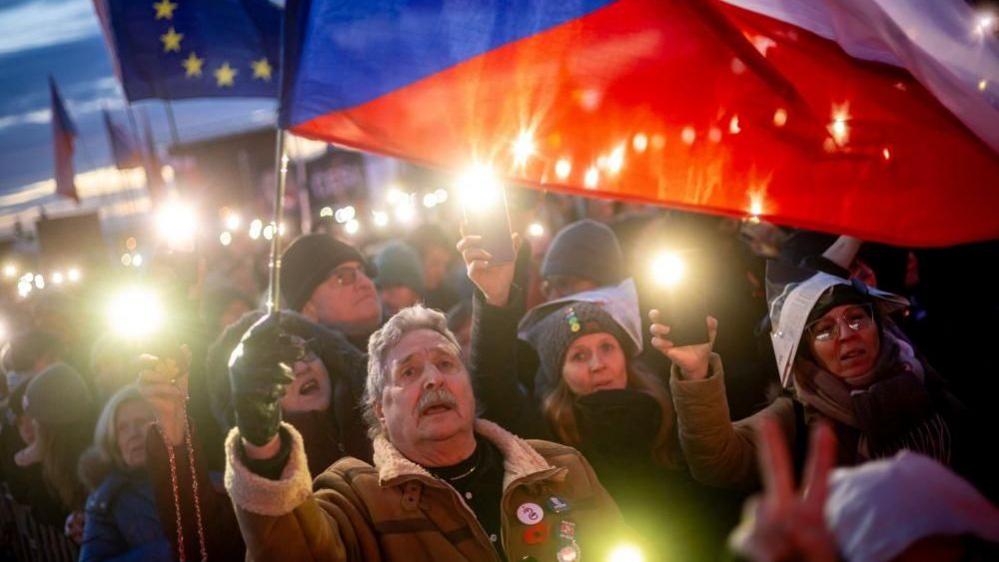

Thousands of people have gathered in central Prague to protest against the Czech government's plans to scrap the licence fee and use the state budget to fund public media.
Critics say the plans would allow politicians to stifle media freedom.
The coalition government - which consists of the populist ANO party and two right-wing Eurosceptic parties - insists the change will not affect editorial independence, but wants broadcasters to cut costs.
Parliament passed the first draft of the proposal late last month. Since then, thousands of Czechs have taken part in protests.
Czech households currently pay 205 crowns ($9.44; £7.06) a month for TV and radio.
Sunday's protest was organised by the Million Moments for Democracy association which said "roughly 400,000" people had attended.
It is being described as the largest protest since the Czech Republic's independence in 1993.
"I know that our entire Czech Television is a guarantee of truth and objectivity," pensioner Milana Rudolfova, 72, told Reuters news agency.
"If we do not have public television and radio then unfortunately we will not be able to believe anything anymore."

Prime Minister Andrej Babis has insisted the government does not want to control public media.
"The funding system is changing, no one wants to control public media, no one wants to dictate to them what they should say and do, no one wants to nationalise them," Babis told the Czech News Agency.
"We are doing this because the system is already outdated and most of Europe is going the same way today and others are joining in," he added.
Some European countries, including France and Norway, have moved away from the public licence fee model in the last few years.
France removed it in 2022 and its public media, which also carries advertising, is now funded by a portion of the income from VAT.
Norway abolished its license fee in 2020 and moved its public broadcaster's funding into the national budget.

Some protesters wore pointed hats folded out of newspapers as a tribute to an animated character, Vecernicek, who has introduced Czech Television's nightly children's bedtime stories for decades.
Critics have compared the government's media bill to changes in Hungary under former Prime Minister Viktor Orbán, who tightly controlled state media when he was in power.
Prime Minister Andrej Babis was appointed in December in 2025, and has faced criticism over his coalition's attacks on Czech media.
"Political attacks against private and public media have become one of the hallmarks of Andrej Babis' premiership," said Pavol Szalai, Prague Bureau director of international press freedom organisation Reporters Without Borders, in June.